

Health savings accounts and Medicare don’t always work the way people think they do. Many beneficiaries miss out on significant tax savings because they’re unsure how these two programs interact.
At Dave Silver Insurance, we’ve seen firsthand how confusion around HSA eligibility and withdrawal rules costs people money. This guide walks you through the real mechanics so you can make decisions that actually benefit your wallet.
When Can You Actually Contribute to an HSA After Turning 65?
The Hard Stop on HSA Contributions
The moment you enroll in any part of Medicare-whether it’s Part A, Part B, or Part D-your HSA contributions stop immediately. This isn’t a suggestion or a guideline. It’s a hard rule enforced by the IRS, and violating it triggers a 6% excise tax on excess contributions plus income tax on the earnings. People turn 65, assume they can keep contributing, and don’t realize the damage until tax time.
If you enroll in Medicare Part A retroactively (which can happen up to six months before your eligibility date), you must halt contributions during that entire lookback window. The IRS Publication 969 makes this clear: enrollment in any part of Medicare makes HSA contributions ineligible, period. Your best move is to stop contributing at least one month before your Medicare coverage begins, not after.
The Strategy for Workers Still Employed
If you’re still working and have employer health coverage, you do have one legitimate option-delay Medicare enrollment entirely and keep contributing. Some workers strategically push off Medicare to maximize HSA funding for future retirement expenses, treating the account as a long-term medical savings vehicle rather than a current-year spending tool. This only works if you actively decline Medicare when you turn 65, which requires a formal election.
What You Can Actually Withdraw Without Penalties
Once you’re on Medicare, your HSA transforms from a contribution account into a withdrawal account. You can pull funds tax-free for any qualified medical expense, which includes Medicare premiums for Parts B, D, and Medicare Advantage, plus deductibles, copays, and coinsurance across all parts. Critically, you cannot use HSA funds for Medigap premiums-this is a frequent mistake that triggers unexpected tax bills.
After age 65, the IRS also relaxes one rule: you can withdraw HSA funds for non-qualified expenses without the 20% penalty, though you’ll owe ordinary income tax on those amounts. This flexibility makes the HSA valuable for covering costs Medicare doesn’t fully address, like dental work, vision care, hearing aids, and long-term care services.
Documentation Protects You from Tax Trouble
The key is documentation. The IRS expects you to track exactly what you paid for and save receipts. If you withdraw funds and can’t prove they covered qualified expenses, the IRS will tax you on the withdrawal and potentially assess penalties. Use your HSA statements and medical records to build a clear audit trail.
For specific guidance on what qualifies, consult IRS Publication 502, which details all eligible medical expenses. Understanding these withdrawal rules now prevents costly mistakes later-and sets you up to use your HSA strategically across all your Medicare coverage options.
How to Spend Your HSA Strategically on Medicare Costs
Calculate Your Total Medicare Expenses First
Once Medicare enrollment stops your contributions, your HSA becomes a powerful tool for reducing out-of-pocket medical expenses. The real advantage lies in understanding exactly what Medicare leaves uncovered and how your HSA can fill those gaps. Medicare Part A covers hospital stays but charges a deductible of $1,736 for 2026. Part B covers doctor visits and outpatient services with a $240 annual deductible plus 20% coinsurance. Part D prescription drug plans have their own deductibles, which averaged $112 in 2024 according to CMS data. Your HSA can pay every one of these costs tax-free, but most people waste their balance on current-year expenses instead of strategically covering the gaps Medicare creates.
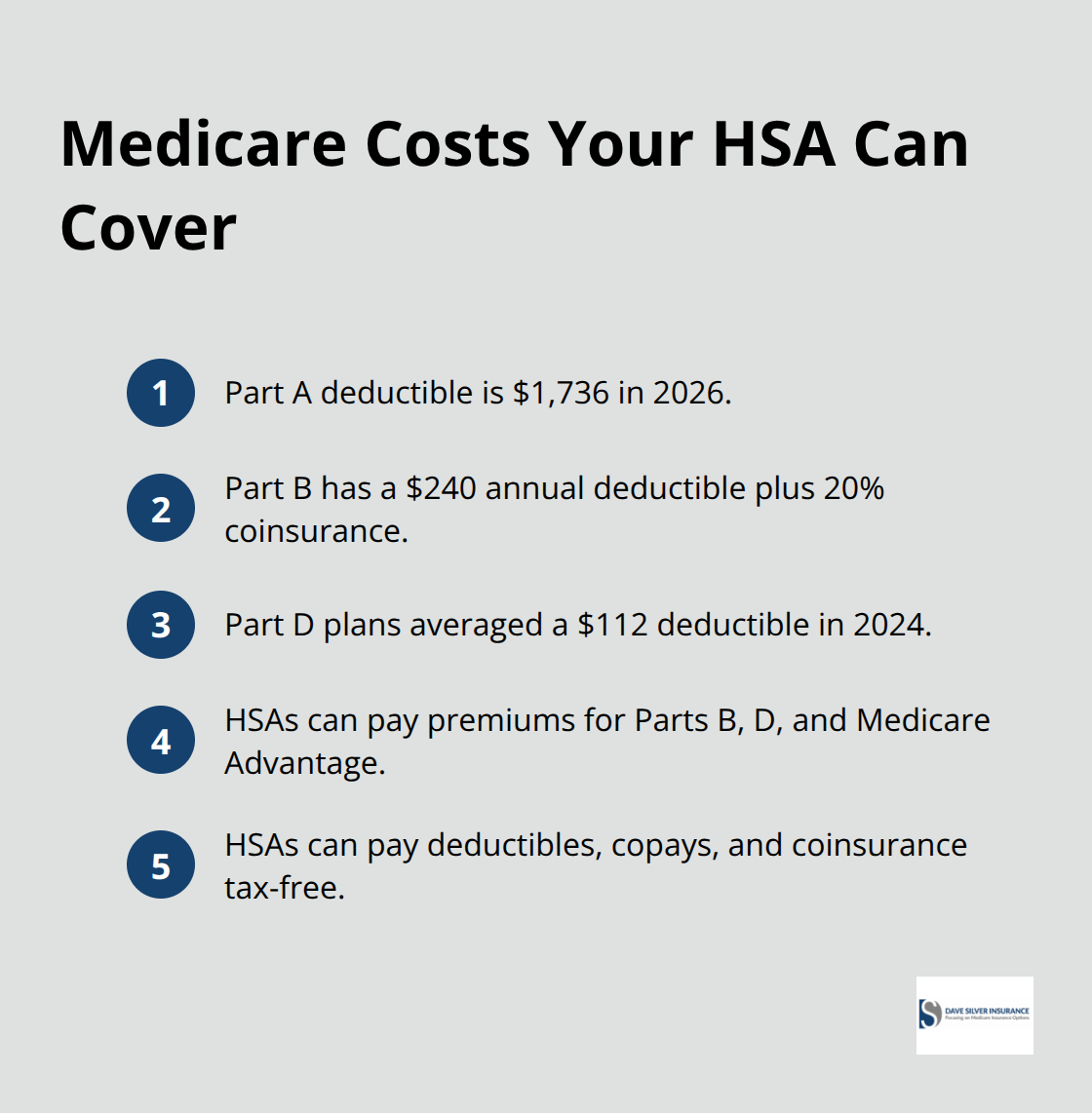
Start by calculating your total annual Medicare costs-premiums, deductibles, copays, and coinsurance-then prioritize those payments through your HSA first. If you have a Medicare Advantage plan, your copays typically range from $0 to $75 per visit depending on the plan, and your HSA covers all of them. Map out your predictable Medicare costs for the year and allocate HSA funds accordingly rather than treating your HSA like a general savings account.
Understand What Your HSA Can and Cannot Cover
The withdrawal rules shift significantly once you turn 65. Before Medicare enrollment, withdrawals for non-qualified expenses trigger a 20% penalty plus income tax. After 65, that 20% penalty disappears, leaving only ordinary income tax on non-qualified withdrawals. This change makes your HSA far more flexible in retirement, but it also creates a temptation to misuse funds.
IRS Publication 969 specifies exactly what qualifies, and the list is narrower than most people assume. You can pay for Medicare Advantage dental and vision coverage if your plan includes it, but you cannot pay Medigap premiums under any circumstance-this is the single most common mistake we see. After covering Medicare expenses, you can use remaining HSA funds for dental work, vision care, hearing aids, and long-term care services (all qualified expenses the IRS allows).
Match Your HSA Strategy to Your Medicare Plan Type
Coordinate your HSA withdrawals with your Medicare plan type. If you have Original Medicare with Medigap, your HSA covers Medigap deductibles and coinsurance, just not the premiums themselves. If you have Medicare Advantage, your HSA covers copays and any out-of-pocket maximums you hit. If you have employer retiree coverage, your HSA pays your share of those premiums after age 65.
Keep receipts for everything and maintain a separate ledger tracking which HSA withdrawals correspond to which medical services. Documentation protects you from tax trouble if the IRS questions your withdrawals.
Preserve Your HSA Balance for Future Medical Needs
The key actionable step is to never withdraw more than you need in any given year. HSA funds grow tax-free if left untouched, making them superior to a regular savings account for long-term medical costs. People often deplete their HSA too quickly on routine expenses, then face higher out-of-pocket costs later when they need it most. Treat your HSA as a last-resort fund for costs Medicare doesn’t cover rather than your first payment method.
This disciplined approach to HSA spending sets the stage for understanding what happens when you make withdrawal mistakes-and how to recover from them.
Where People Go Wrong With HSA and Medicare Rules
The mistakes we see most often stem from one source: people treat their HSA the same way after turning 65 as they did before. The rules change fundamentally once Medicare enters the picture, and that shift catches most beneficiaries off guard. IRS Publication 969 outlines these changes clearly, but few people read it until after they’ve already made costly errors. We’ve watched clients lose thousands in unexpected tax bills because they didn’t understand when contributions stop, what withdrawals actually qualify, and how Medicare enrollment timing affects their entire strategy. The good news is that these mistakes are entirely preventable with the right information upfront.
Continuing Contributions After Medicare Enrollment Triggers Immediate Penalties
The most expensive mistake people make is continuing to contribute to your HSA after enrolling in Medicare. The moment you enroll in any part of Medicare-Part A, Part B, Part D, or Medicare Advantage-your contribution eligibility ends. If you keep depositing money after that point, the IRS assesses a 6% excise tax on each excess contribution, plus you’ll owe income tax on any earnings that accumulated in those funds. The penalty applies every single year you make excess contributions, compounding the damage.
If you’re automatically enrolled in Medicare when you turn 65 and claim Social Security benefits, you must stop HSA contributions immediately-not at the end of the calendar year, but in the month your coverage begins. The six-month retroactive window for Medicare Part A makes this even trickier: if Part A coverage goes back six months, your contributions during that entire lookback period become excess contributions subject to penalty, even if you didn’t know you were enrolled.
Using HSA Funds for Ineligible Expenses Costs More Than You Spend
People routinely withdraw HSA funds for expenses that don’t qualify, either because they misunderstand the rules or they simply need cash. Medigap premiums are the most common culprit-beneficiaries assume their HSA covers all Medicare-related costs and then discover the IRS disallows Medigap premium payments entirely. That withdrawal triggers ordinary income tax plus a 20% penalty if you’re under 65 (or just ordinary income tax if you’re over 65). A $300 Medigap premium withdrawal becomes $360 in tax liability at a 20% marginal rate, plus the 20% penalty equals $60, totaling $420 out of pocket for a $300 expense.
Over time, small misunderstandings compound into serious tax bills. Dental work, vision care, and hearing aids do qualify, but gym memberships, cosmetic procedures, and general wellness products do not. IRS Publication 502 specifies every eligible expense, and the list is narrower than most people assume. The safest approach is to verify every withdrawal against Publication 502 before touching your funds, then save receipts documenting exactly what you paid for.
Missing the Contribution Deadline Window Costs You Years of Tax-Free Growth
The third major mistake is failing to maximize HSA contributions in the months before Medicare enrollment. Your HSA grows tax-free indefinitely-earnings compound without any tax drag-making it far superior to a regular savings account for long-term medical costs. Someone who stops contributing too early leaves money on the table that could have grown for decades. If you’re still employed with employer health coverage and plan to delay Medicare, you can continue maximizing contributions at the 2026 limit of $4,150 for individual coverage. But you must act before your Medicare eligibility date arrives.
Many people wait too long, assuming they’ll get another contribution season, then watch their window close when they turn 65 or claim Social Security. The strategic move is to plan your Medicare enrollment date at least six months in advance, then front-load HSA contributions during the months you remain eligible. If you’re turning 65 mid-month and want to squeeze in one final contribution, stop all deposits by the month before your coverage begins to avoid triggering the retroactive lookback penalty. The difference between maximizing contributions for one more year versus missing the deadline is tens of thousands in lost tax-free growth over retirement.
Final Thoughts
The relationship between health savings accounts and Medicare requires deliberate planning, not assumptions. The rules shift dramatically once you enroll in Medicare-you cannot contribute after enrollment begins, but you can withdraw funds tax-free for qualified medical expenses including Medicare premiums, deductibles, copays, and coinsurance. The mistakes outlined in this guide (continuing contributions after enrollment, using funds for ineligible expenses like Medigap premiums, and missing contribution deadlines) are entirely preventable with the right strategy.
Start by calculating your total annual Medicare costs across all parts and plan types, then map out exactly which HSA withdrawals will cover those gaps. Document everything and verify each withdrawal against IRS Publication 502 before touching your funds. If you’re still employed with employer coverage, consider whether delaying Medicare makes sense to extend your contribution window and build a larger tax-free balance for retirement medical expenses.
One missed deadline or one ineligible withdrawal can cost thousands in unexpected tax bills. At Dave Silver Insurance, we help beneficiaries navigate these exact decisions with personalized guidance on Medicare Parts A, B, C, and D, plus Medigap options tailored to your situation. If your health savings accounts and Medicare situation feels unclear, a consultation with a professional who understands both programs eliminates guesswork and protects your savings.
Disclaimer: The information provided in this blog is for general informational purposes only and does not constitute legal, financial, or insurance advice. Coverage options, terms, and availability may vary. Please consult with a licensed professional for advice specific to your situation