

Your income directly affects which Medicare plans you qualify for and how much you’ll pay in premiums. Medicare income limits determine whether you’re eligible for certain coverage options and can trigger higher costs through income-related adjustments.
At Dave Silver Insurance, we help people understand how their earnings impact their Medicare choices. This guide walks you through the income thresholds, coverage options available at different income levels, and strategies to optimize your benefits.
How Medicare Income Limits Affect Your Premiums and Coverage
Understanding Modified Adjusted Gross Income
Modified Adjusted Gross Income, or MAGI, is the number Medicare uses to decide whether you pay standard premiums or face income-related surcharges on Part B and Part D. MAGI differs from your regular adjusted gross income on your tax return. Medicare adds back certain deductions, like tax-exempt interest from municipal bonds, which means your MAGI can exceed what you report to the IRS. This distinction matters because it directly affects your monthly Medicare costs.
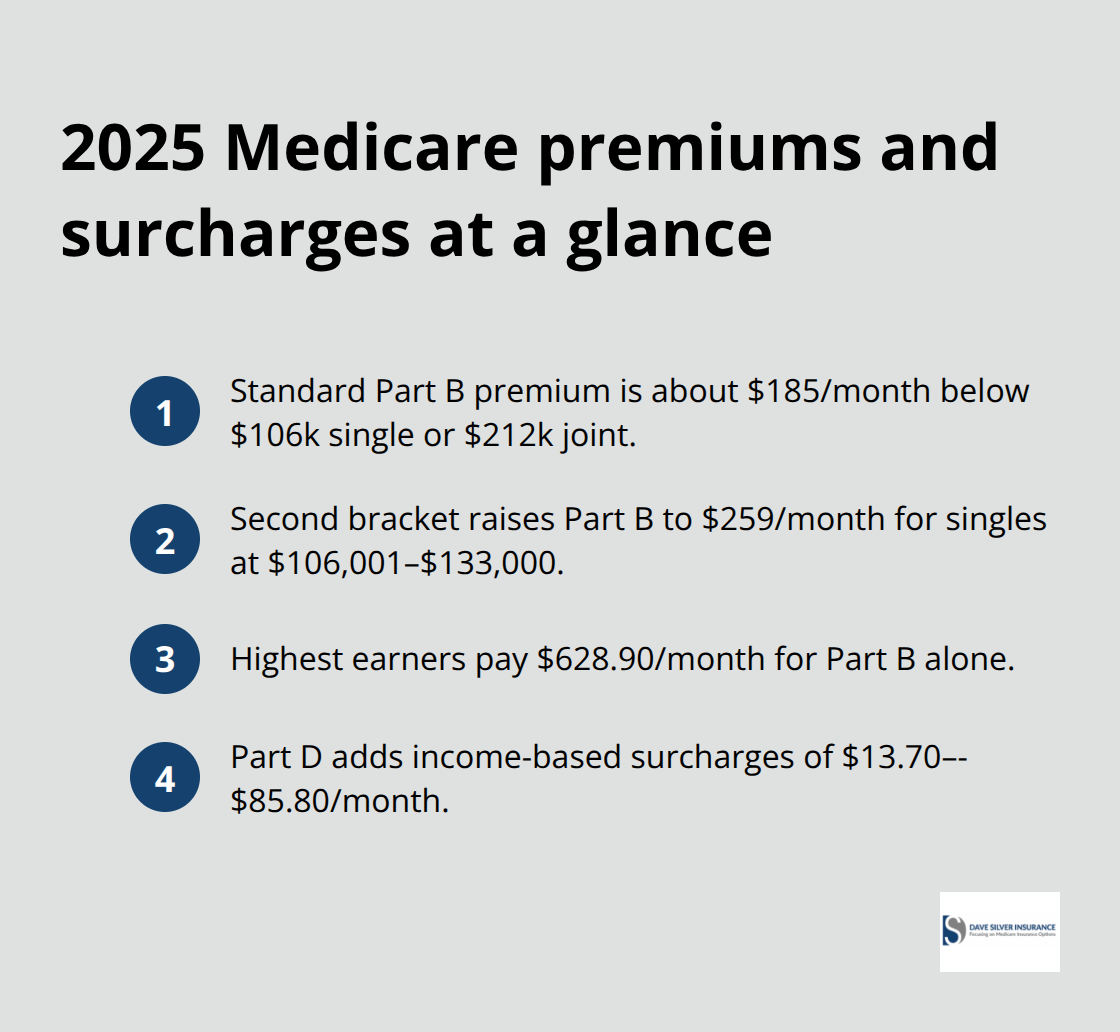
For 2025, if your MAGI falls below $106,000 as a single filer or $212,000 as a married couple filing jointly, you pay the standard Part B premium of around $185 per month. Cross that threshold into the second bracket at $106,001 to $133,000 for singles, and your Part B premium jumps to $259 per month-a $74 monthly surcharge. The brackets continue upward, with the highest earners paying $628.90 monthly for Part B alone. Part D premiums follow the same logic, starting with plan-specific costs but adding surcharges ranging from $13.70 to $85.80 depending on your income bracket.
The Two-Year Lag That Catches People Off Guard
Medicare calculates your IRMAA, or Income-Related Monthly Adjustment Amount, based on your MAGI from two years prior. This lag means a major retirement income event in 2024-like cashing in restricted stock or taking your first Required Minimum Distribution-won’t hit your 2024 premiums but will increase your 2026 costs significantly. Your income decisions today directly determine your IRMAA bracket two years from now, so understanding this timing allows you to plan ahead rather than face unexpected bills.
Retirement Income Events That Trigger Higher Costs
Several common retirement decisions push you into higher IRMAA brackets without warning. Vesting restricted stock units or exercising stock options creates immediate taxable income that appears on your tax return two years later. Required Minimum Distributions from retirement accounts at age 73 can cause a substantial spike in MAGI, especially if you delay your first distribution and end up taking two in a single year. Roth conversions are fully taxable in the year of conversion, so converting $100,000 from a traditional IRA to a Roth could jump your MAGI enough to trigger IRMAA surcharges two years out. Capital gains from selling a home above the exclusion amount ($250,000 for individuals, $500,000 for joint filers) count toward MAGI. Inherited IRA withdrawals are also taxable income. These events aren’t avoidable for most people, but understanding the timing allows you to plan strategically.
Income Thresholds and Your Medicare Coverage Options
Your income determines eligibility for programs that reduce out-of-pocket costs. Medicare Savings Programs, run by individual states, help qualifying beneficiaries pay Part A and B premiums, deductibles, and copayments. The Qualified Medicare Beneficiary program, or QMB, covers all Part A and B costs for individuals with monthly income below $1,350 or married couples below $1,824 in 2026. The Specified Low-Income Medicare Beneficiary program, SLMB, pays Part B premiums for those with income up to $1,616 for individuals and $2,184 for couples. Both programs automatically qualify you for Extra Help with prescription drug costs.
If you’re near these income thresholds, apply through your state even if you think you don’t qualify, because some states count income differently or allow slightly higher limits. For those with higher incomes, Medicare Advantage and Medigap policies remain available regardless of MAGI, but income-related premiums still apply.
How Income Creates Distinct Tiers of Affordability
Income limits create distinct tiers of affordability across the Medicare landscape. Below the Medicaid threshold in your state, you access comprehensive cost assistance. In the middle range, you manage standard premiums and IRMAA surcharges. Above the highest IRMAA brackets, your Part B and D costs stabilize, but you’ve already paid substantial surcharges to reach that point. These income tiers shape not only what you pay but also which plans make financial sense for your situation-a reality that becomes clearer when you examine how different plan types respond to your income level.
Which Medicare Plan Works Best at Your Income Level
How Income Shapes Your Plan Options
Your income doesn’t just affect premiums-it determines which plans actually make financial sense for your situation. Original Medicare remains available to everyone regardless of MAGI, but income-related surcharges on Part B and Part D climb steeply as earnings rise. At lower income levels, Medicare Savings Programs eliminate these costs entirely, making Original Medicare paired with Medigap highly competitive. In the middle-income range between $50,000 and $150,000 for individuals, IRMAA surcharges start appearing but remain modest, typically $74 to $185 monthly on Part B alone. Above $200,000 in MAGI, Part B premiums reach $628.90 monthly-a substantial hit that forces many higher-income beneficiaries to reconsider their approach.
Medicare Advantage’s Income-Neutral Pricing
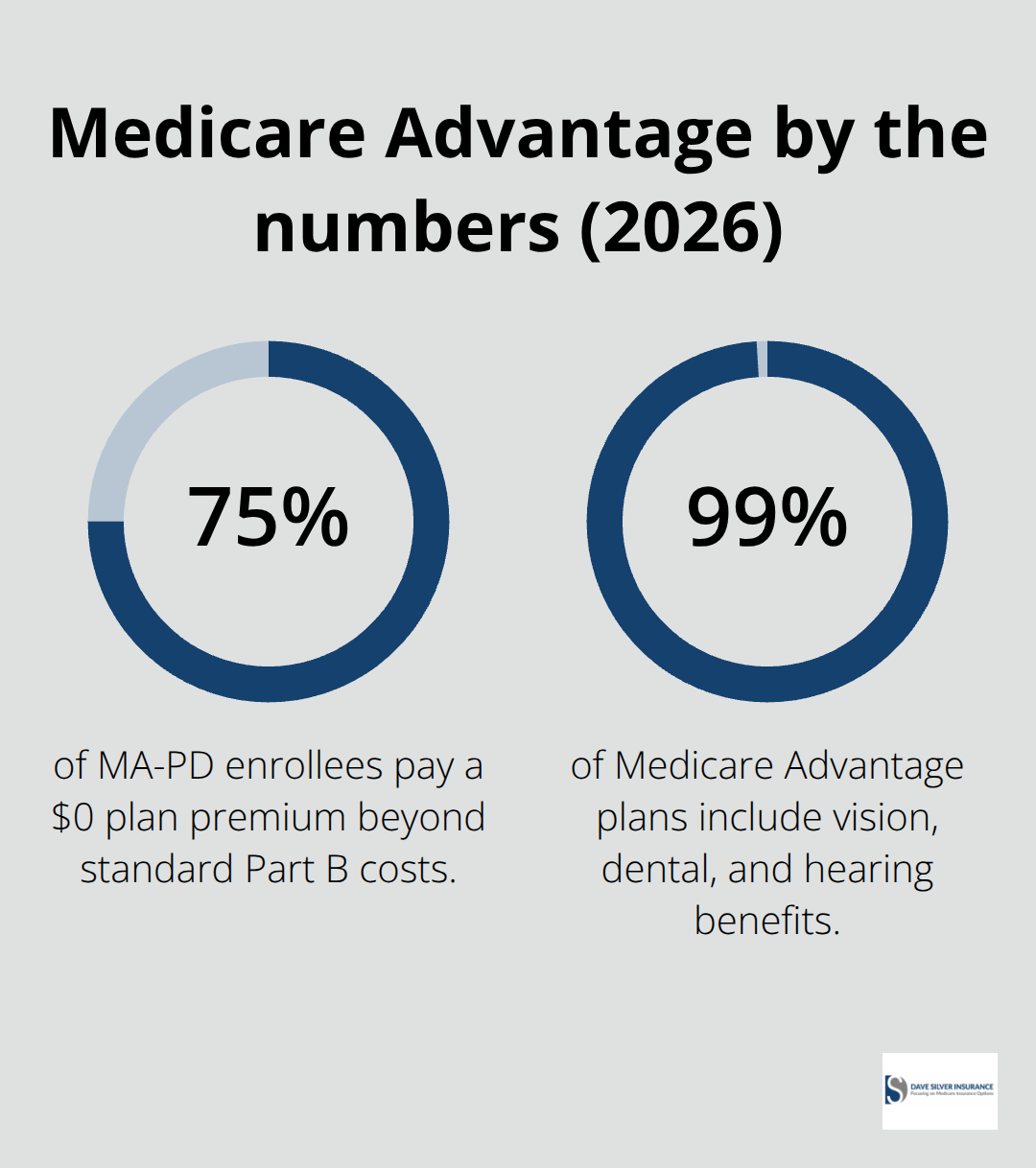
Medicare Advantage plans operate differently from Original Medicare. They cap your out-of-pocket costs regardless of income, and according to data from the Kaiser Family Foundation in 2026, 75% of Medicare Advantage with Part D enrollees pay zero premium beyond standard Part B costs. This zero-premium advantage applies across income levels, meaning a high earner and a low earner in the same plan pay identical plan premiums.
The real difference emerges in how you manage IRMAA surcharges alongside your chosen plan. For those earning above $106,000 as a single filer, the math shifts toward Medicare Advantage because the plan’s network and out-of-pocket caps become more valuable when you’re already paying substantial Part B surcharges.
Medicare Advantage plans in 2026 average an in-network out-of-pocket limit of $4,636 for HMO enrollees and $6,592 for PPO enrollees (according to KFF data), compared to Original Medicare’s unlimited exposure. At higher income levels, this cap protection matters more because you’re likely to use healthcare services and face higher costs. Additionally, 99% of Medicare Advantage plans include supplemental benefits like vision, dental, and hearing coverage that Original Medicare doesn’t cover-benefits that become financially significant as you age.
Original Medicare and Medigap at Higher Incomes
Medigap policies address Original Medicare’s gaps but cost extra, typically ranging from $100 to $300 monthly depending on your age and location, which adds to your IRMAA burden at higher incomes. The interaction between Medigap premiums and IRMAA surcharges often makes Medigap less attractive above $150,000 in MAGI. Part D prescription drug coverage adds another layer: if you enroll in Original Medicare with a Medigap plan, you must also purchase a standalone Part D plan, creating three separate premium payments. Medicare Advantage bundles Part D into one plan, simplifying administration and often reducing total costs for middle and higher-income beneficiaries.
Prescription Drug Coverage and Income Thresholds
Lower-income beneficiaries qualifying for Extra Help through Medicare Savings Programs pay minimal or no Part D copayments regardless of plan type, but those above the MSP thresholds face plan-specific deductibles and tiered copayments that vary widely. At your income level, comparing the total annual cost of Original Medicare plus Medigap plus Part D against Medicare Advantage’s bundled premium and out-of-pocket structure is essential before enrollment. This comparison becomes your foundation for understanding which plan type actually saves you money-and that analysis leads directly into the strategies you can use to manage your income and optimize your Medicare benefits.
How to Reduce Your Income Before IRMAA Hits Your Premiums
The two-year lag in IRMAA calculations creates a genuine window to shape your tax situation before surcharges take effect. If you face a major retirement income event in 2024, you can still influence what Medicare charges you in 2026. The strategies that work best depend on your specific income sources and how much control you have over timing.
Spread Large Conversions Across Multiple Years
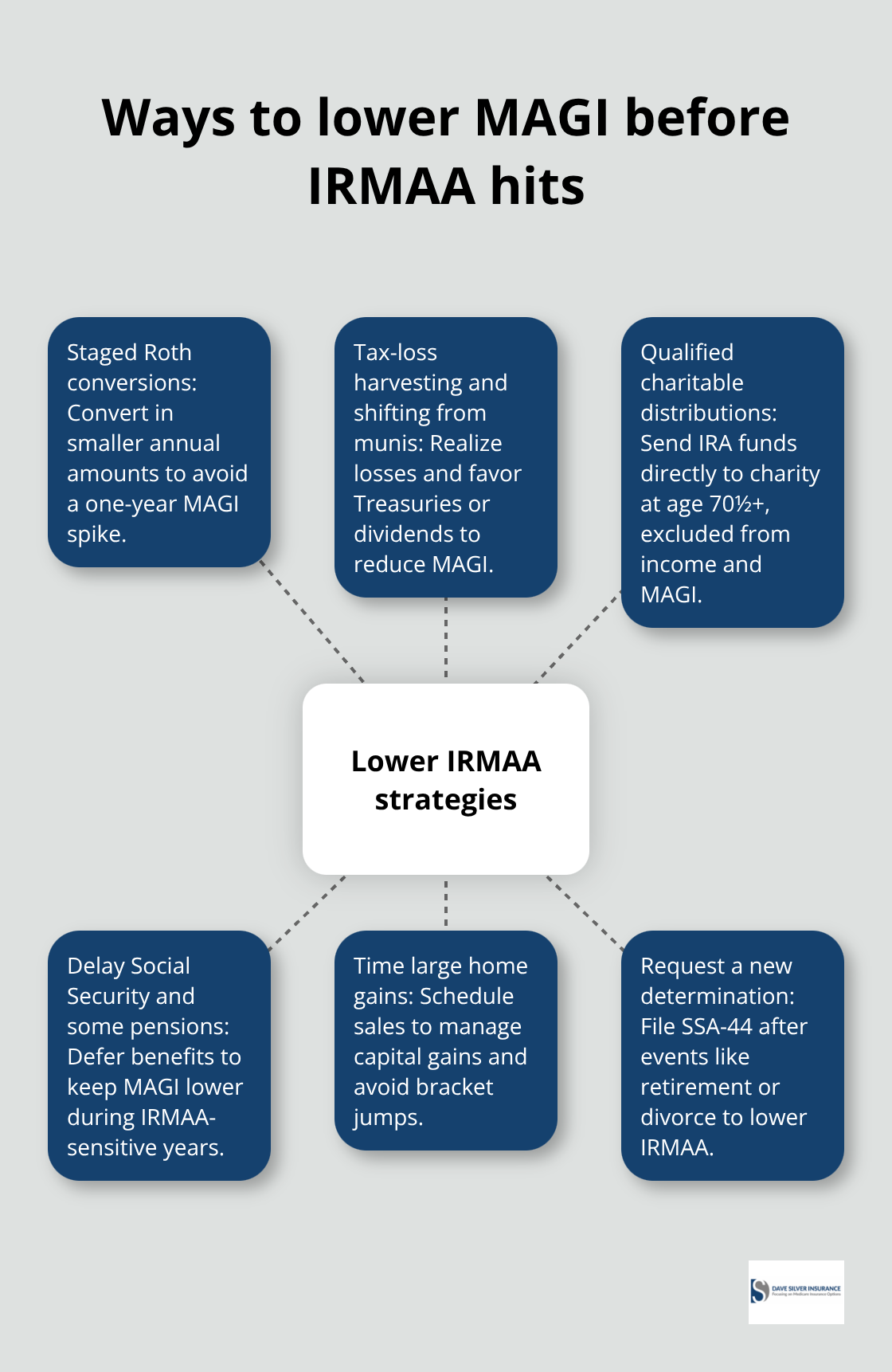
Staged Roth conversions spread taxable income across multiple years instead of creating a single spike that pushes you into a higher bracket. If you plan to convert $200,000 from a traditional IRA to a Roth, converting $50,000 per year over four years keeps your MAGI stable rather than jumping it dramatically in one year. This approach requires advance planning but delivers measurable results in your IRMAA calculations two years out.
Use Tax-Loss Harvesting and Asset Shifts
Tax-loss harvesting in taxable investment accounts offsets capital gains and reduces your total taxable income when you sell appreciated assets. Municipal bond interest gets included in MAGI for Medicare calculations even though it remains exempt from federal income tax, so shifting away from munis toward Treasury bonds or dividend-focused stocks lowers your MAGI without reducing your total return. These adjustments work quietly in the background but compound over time.
Leverage Charitable Distributions and Home Sale Timing
Qualified charitable distributions for those age 70½ and older let you distribute funds directly from your IRA to charity, which counts neither as taxable income nor MAGI. This strategy proves particularly powerful if you take Required Minimum Distributions and want to reduce your IRMAA impact. Timing the sale of an appreciated home matters too: the $250,000 individual exclusion and $500,000 joint exclusion cover most gains, but anything above that threshold adds to MAGI two years later.
Deferring the sale by one year can shift those gains to a different tax year and potentially lower your IRMAA bracket.
Delay Social Security and Pension Distributions
The most overlooked strategy involves deferring Social Security and pension distributions if you have that option. Deferring Social Security benefits past your full retirement age increases your monthly payment by 8% per year, and those higher payments never trigger IRMAA adjustments retroactively. If you can cover living expenses from other sources during your early retirement years, waiting until 70 to claim Social Security locks in much higher permanent benefits while keeping your MAGI lower during your mid-60s and early 70s, when you face the most vulnerability to IRMAA surcharges. Similarly, some pension plans allow you to defer distributions beyond your initial eligibility date. Nonqualified dividends and capital gains can shift to tax-deferred accounts or restructure through your investment approach. If you receive a large inheritance or settlement, spreading the distributions across multiple years through a structured settlement rather than taking a lump sum reduces your MAGI in any single year.
Request a New Determination After Life Changes
The Social Security Administration administers IRMAA determinations, and you can request a new determination using Form SSA-44 if a life-changing event like job loss or divorce reduces your household income. This form lets you exclude the current year’s income from your IRMAA calculation if your circumstances have changed significantly since your tax return was filed two years prior. A financial or tax advisor who understands Medicare’s income rules makes the difference between paying thousands in unnecessary surcharges and keeping your premiums manageable.
Final Thoughts
Your income directly shapes your Medicare costs and plan options, but understanding how Medicare income limits work gives you real control over your financial situation. The two-year lag between your income and IRMAA surcharges creates an opportunity to spread large transactions strategically, time Roth conversions across multiple years, and use qualified charitable distributions to keep your MAGI manageable. Major retirement decisions like Required Minimum Distributions and home sales don’t have to blindside you with unexpected premium increases when you plan ahead.
If you earn below the Medicare Savings Program thresholds, apply through your state immediately-some states count income differently, and you may qualify for assistance that eliminates your Part A and B costs entirely. If you’re in the middle-income range facing modest IRMAA surcharges, compare Original Medicare with Medigap against Medicare Advantage’s bundled approach to find what works for your situation. Higher earners benefit from Medicare Advantage’s income-neutral plan premiums and built-in out-of-pocket caps that protect against unlimited costs.
We at Dave Silver Insurance help people navigate these decisions with clarity and confidence. Our team brings over 17 years of Medicare expertise and works with you seven days a week to understand your unique health and financial needs. Schedule a consultation with us to review your Medicare income limits and discover how to optimize your coverage without overpaying in premiums.
Disclaimer: The information provided in this blog is for general informational purposes only and does not constitute legal, financial, or insurance advice. Coverage options, terms, and availability may vary. Please consult with a licensed professional for advice specific to your situation