

Many veterans don’t realize they’re leaving thousands of dollars in benefits on the table each year. Between veteran Medicare benefits and VA coverage, the coordination options are complex-and one wrong move during enrollment can cost you.
At Dave Silver Insurance, we’ve helped countless veterans navigate this maze. This guide walks you through the strategies that actually work.
How Medicare and VA Benefits Actually Coordinate
Medicare and VA operate as two completely separate systems that don’t automatically talk to each other. This is the critical fact most veterans miss. You don’t choose between them-you use both, but strategically for different services. VA covers care at VA facilities and through VA-authorized providers, while Medicare covers care at any Medicare-participating hospital or doctor’s office nationwide. The key involves deciding which program pays for each specific service based on where you receive care and what offers better value. According to VA.gov, VA health care services are provided only at VA facilities, even if you’re enrolled in Medicare. This means if you need surgery at a non-VA hospital, Medicare becomes your primary coverage option. If you receive the same service at a VA facility, you use VA benefits instead. The programs don’t coordinate billing automatically, so you must actively choose which to use for each care event.
Many veterans assume having VA coverage means they don’t need Medicare-this is backwards. A JAMA Surgery study found that VA facilities have about 20% lower mortality for certain surgeries compared with comparable non-VA facilities, which is impressive. However, not every veteran has convenient VA access, and not every condition can be treated at a VA facility within a reasonable timeframe. Medicare fills these gaps. If you live far from a VA medical center, Medicare’s nationwide provider network becomes invaluable for routine care, specialists, and emergencies. If you travel frequently, Medicare Part B coverage follows you anywhere in the country, while VA benefits remain limited to VA locations or VA-authorized community care.
Your Priority Group Determines VA Costs and Access
VA Priority Groups range from 1 to 8, and your group directly affects what you pay and when you can access care. Priority Group 1 includes veterans with 100% service-connected disabilities and typically means no copays for most VA services-inpatient care, outpatient visits, and medications. This group has the strongest incentive to rely on VA first. Priority Groups 2 through 8 face higher copays, limited services, and potential wait times. According to VA.gov, veterans with service-connected disabilities receive the highest priority. If you’re in Priority Group 5 or lower, you’ll pay copays at VA facilities for primary care and specialist visits. These costs add up quickly.
In contrast, Medicare Part B costs about $174.70 per month in 2026 with a $240 annual deductible and 20% coinsurance for most services. For routine care, your VA copays might actually be lower than Medicare’s cost-sharing. But for expensive procedures or specialist care outside VA’s capabilities, Medicare may offer better value. Your priority group status should influence whether you prioritize VA or Medicare for specific services.
Prescription Drug Coverage Requires Active Comparison
VA prescription drug coverage is free or nearly free-most veterans pay $0 to $11 per month for VA medications through the VA formulary. Medicare Part D costs vary widely, typically $30 to $100 per month depending on the plan, plus additional costs for covered drugs. However, VA drug coverage only works at VA pharmacies, while Part D offers access to retail pharmacies nationwide. According to VA.gov, VA drug coverage is creditable coverage, meaning you can delay enrolling in Part D without penalties if VA covers your prescriptions. The catch: if your medication isn’t on the VA formulary, you must either request an exception, appeal, or pay out of pocket.
Part D plans have their own formularies with different drug coverage. If you take medications not covered by VA, Part D becomes essential. Many veterans benefit from maintaining both coverages. Use VA for routine medications you can obtain at VA pharmacies, and use Part D for drugs not on the VA formulary or when you need local pharmacy convenience. Comparing both formularies before age 65 takes two hours and prevents months of prescription headaches later. This comparison sets the stage for understanding how to coordinate all your benefits strategically-a process we’ll explore in the next section on avoiding common enrollment mistakes.
How to Choose Which Program Pays for Each Service
Map Your Care Needs Against Actual Costs
The real money-saving strategy isn’t picking VA or Medicare-it’s deciding which one to use for each specific medical event based on cost and convenience. Start by mapping your regular care needs against both programs’ actual costs. If you’re Priority Group 1 with 100% service-connected disability, VA covers inpatient care, outpatient visits, and medications at zero or near-zero copay. For you, VA should be your first choice for routine care, preventive services, and medications available on the VA formulary. However, even Priority Group 1 veterans benefit from Medicare Part B because it covers services VA doesn’t provide, like skilled nursing facilities and certain post-acute care. Medicare Part B costs about $174.70 monthly in 2026, but it unlocks access to non-VA hospitals, specialists outside the VA network, and nationwide coverage if you travel or relocate.
If you’re Priority Group 5 or lower, your VA copays climb significantly-primary care visits typically cost $15 to $50, and specialist visits run $50 or more per visit. At that point, comparing costs becomes essential. A $50 VA copay plus a $240 Medicare deductible might total less than multiple VA specialist copays for the same condition. Run the actual numbers for your most frequent care needs before deciding which program to prioritize.
Compare Prescription Drug Costs and Access
VA medications cost $0 to $11 monthly through the VA formulary, while Medicare Part D plans include premiums plus per-drug costs. If your current medications are all on the VA formulary and you live within reasonable distance of a VA pharmacy, staying with VA for prescriptions is the financially correct choice. However, if you take even one medication not covered by VA’s formulary or if you prefer the convenience of local retail pharmacies, Part D becomes necessary. The VA website lists which drugs require exceptions or appeals, so check your specific medications before assuming VA covers them.
Request Cost Estimates for Major Procedures
For expensive procedures or specialist consultations, call ahead and ask both your VA facility and a Medicare-participating provider for cost estimates. A cardiac catheterization might cost $3,000 in copays through VA or $1,500 through Medicare depending on your Priority Group and the facility’s efficiency. Preventive services like annual physicals, cancer screenings, and vaccinations are covered at no cost by both VA and Medicare, so use whichever location is more convenient.
Track Your Actual Service Usage Patterns
The VA Community Care Program allows non-VA care when VA can’t provide needed services promptly or due to distance, which means you’re not locked into one system. Track which services you actually use each year-if you see a VA doctor twice annually and a specialist outside VA four times yearly, Medicare becomes the better foundation with VA as a supplement rather than the reverse. This usage pattern directly shapes whether you should prioritize VA enrollment or Medicare enrollment first, a decision that affects your long-term cost structure and access to specialists.
Where Veterans Lose Thousands by Missing Enrollment Deadlines
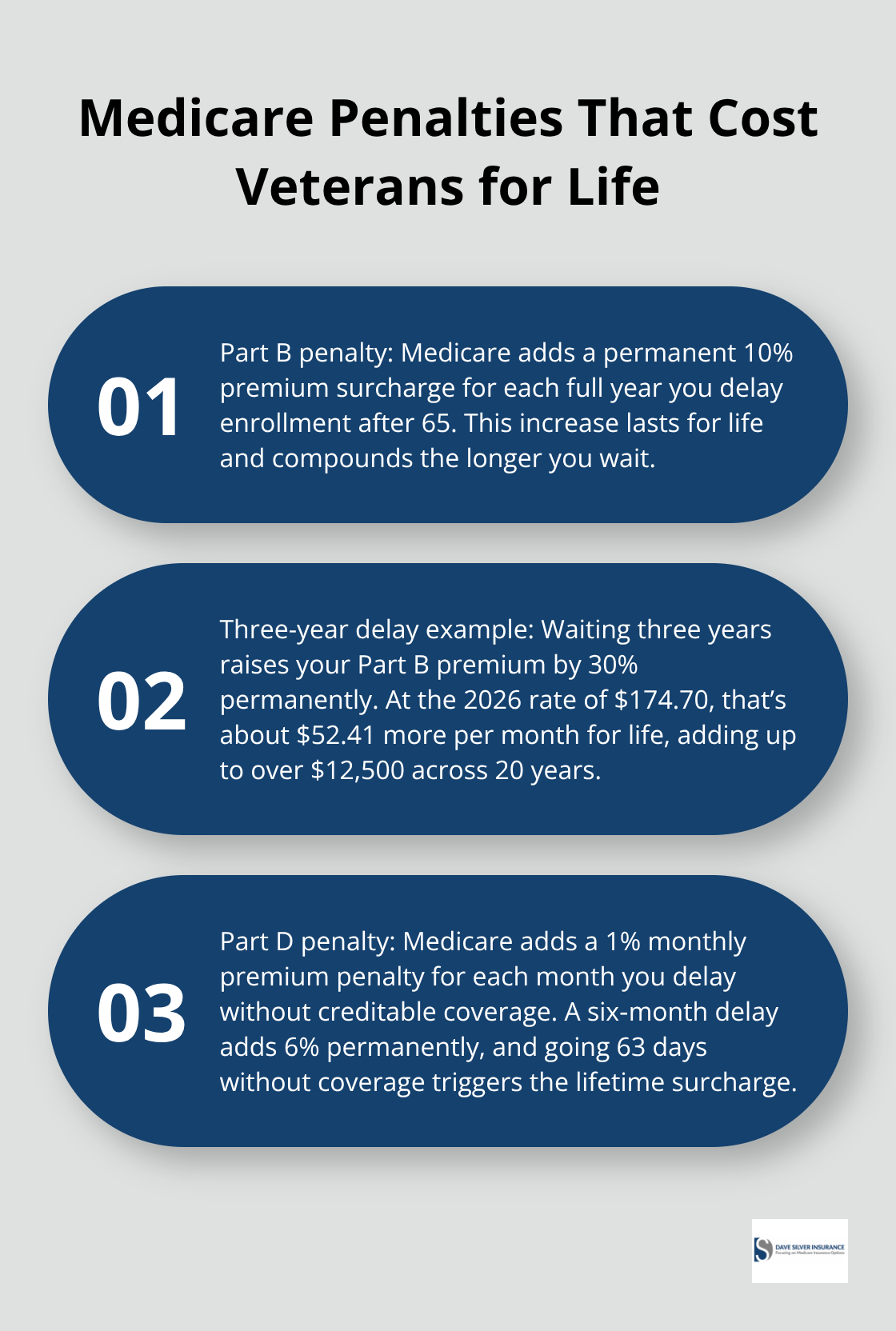
Delaying Medicare Part B enrollment costs you money for life, and most veterans don’t realize this until it’s too late. Medicare imposes a 10% permanent penalty on your Part B premium for each year you delay enrollment after turning 65, and this penalty sticks with you forever according to Medicare.gov. If you delay Part B for three years and then enroll, your monthly premium increases permanently by 30%. At the current 2026 rate of $174.70 monthly, that’s an extra $52.41 per month for the rest of your life. Over 20 years of retirement, delaying just three years costs you over $12,500 in excess premiums.
Why VA Coverage Alone Won’t Protect You
The VA Community Care Program doesn’t exempt you from this penalty. Even if VA covers your routine care today, VA funding can shift, and lower-priority groups face potential coverage reductions during budget constraints. Veterans who assumed VA would always be available and skipped Medicare Part B now pay penalties they can never escape.
Part B enrollment must happen within seven months of turning 65 (your Initial Enrollment Period) or during the General Enrollment Period from January 1 through March 31 each year, with coverage starting the following July. Missing these windows costs immediate money and compounds for decades.
Part D Penalties Hit Just as Hard
Medicare Part D enrollment follows the same penalty structure. If you don’t enroll in Part D when eligible and VA drug coverage doesn’t count as creditable coverage for your situation, Medicare charges a 1% monthly penalty on your Part D premium for each month you delay. A six-month delay adds 6% to your premium permanently. More critically, if you go 63 days without prescription drug coverage and then enroll, you face this lifetime penalty.
VA.gov confirms that VA drug coverage is creditable, meaning you can delay Part D without penalty if VA covers your medications. However, you must actively verify your specific medications are on the VA formulary before relying on this. Many veterans discover too late that their blood pressure medication or arthritis drug requires an exception or isn’t covered at all.
Take Action Before Your Enrollment Window Closes
Enroll in Medicare Part B at 65 even if you have solid VA coverage. Check the VA formulary at VA.gov for each medication you currently take. If even one medication isn’t listed or requires an exception, enroll in Part D during your Initial Enrollment Period. These enrollment windows close fast, and the financial consequences last decades. For personalized guidance on Medicare enrollment and how it coordinates with your VA benefits, consider speaking with a benefits counselor or licensed insurance agent who can review your specific situation and medications.
Final Thoughts
Maximizing your veteran Medicare benefits requires you to treat VA and Medicare as complementary tools rather than competing options. Your Priority Group status shapes VA costs, enrollment deadlines carry permanent financial consequences, and prescription drug coverage demands active comparison between VA formularies and Part D plans. The veterans who save the most money map their actual care patterns, compare costs for specific services, and make deliberate choices about which program to use for each medical event.
Start by verifying your VA Priority Group status and reviewing your current medications against the VA formulary at VA.gov. Mark your calendar for Medicare enrollment if you’re approaching 65, or confirm you enrolled during your Initial Enrollment Period if you’re already eligible. Gather cost estimates from both VA and Medicare-participating providers for any major procedures you anticipate, since these three steps take a few hours and prevent thousands in wasted premiums.
If coordinating these programs feels overwhelming, we at Dave Silver Insurance specialize in helping veterans understand how Medicare and VA benefits work together. Our team provides personalized guidance on Medicare Parts A, B, C, and D, plus Medigap options to reduce your out-of-pocket costs, and we’re accessible seven days a week. Contact Dave Silver Insurance to review your coverage, confirm you’re enrolled correctly, and identify money you might be leaving on the table.
Disclaimer: The information provided in this blog is for general informational purposes only and does not constitute legal, financial, or insurance advice. Coverage options, terms, and availability may vary. Please consult with a licensed professional for advice specific to your situation