

Medicare quotes pricing can vary wildly depending on your age, health status, and location. Most people don’t realize they’re overpaying because they never compare plans side by side.
At Dave Silver Insurance, we’ve helped thousands of people find plans that actually match their needs and budget. This guide walks you through the exact steps to compare Medicare plans effectively and avoid costly mistakes.
How Medicare Plan Pricing Works
Understanding Premium Costs Across Part A, B, C, and D
Medicare pricing breaks down into distinct components, and understanding each one prevents surprise bills. Part A covers hospital stays with no monthly premium for most people, but you’ll face a deductible per benefit period in 2024. Part B, which covers doctor visits and outpatient services, costs monthly for most beneficiaries in 2024, plus an annual deductible. Part D prescription drug coverage ranges from $7 to $100+ monthly depending on the plan and your medications. Part C, also called Medicare Advantage, bundles Parts A, B, and D into one plan with premiums starting around $0 to $150 monthly, though you still pay Part B premiums separately.
Deductibles, Copayments, and Out-of-Pocket Maximums
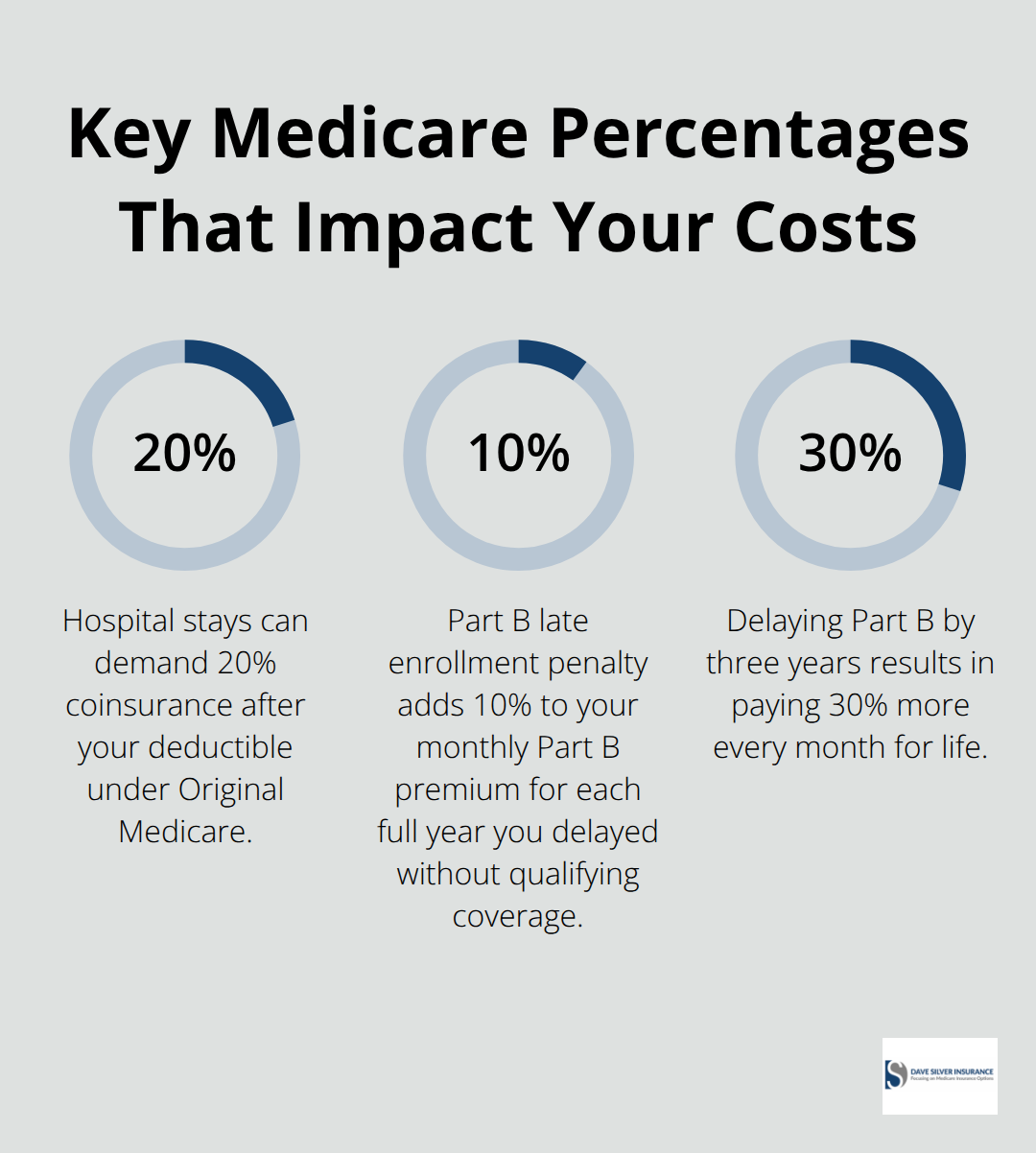
The real cost trap emerges when you ignore copayments and coinsurance. A doctor visit costs $20 to $50 per appointment, while hospital stays demand 20% coinsurance after your deductible. Out-of-pocket maximums matter significantly: Original Medicare has no annual maximum, meaning costs can spiral indefinitely, while Medicare Advantage plans cap your spending annually. This difference alone can save or cost you thousands yearly.
Regional Variations in Plan Costs
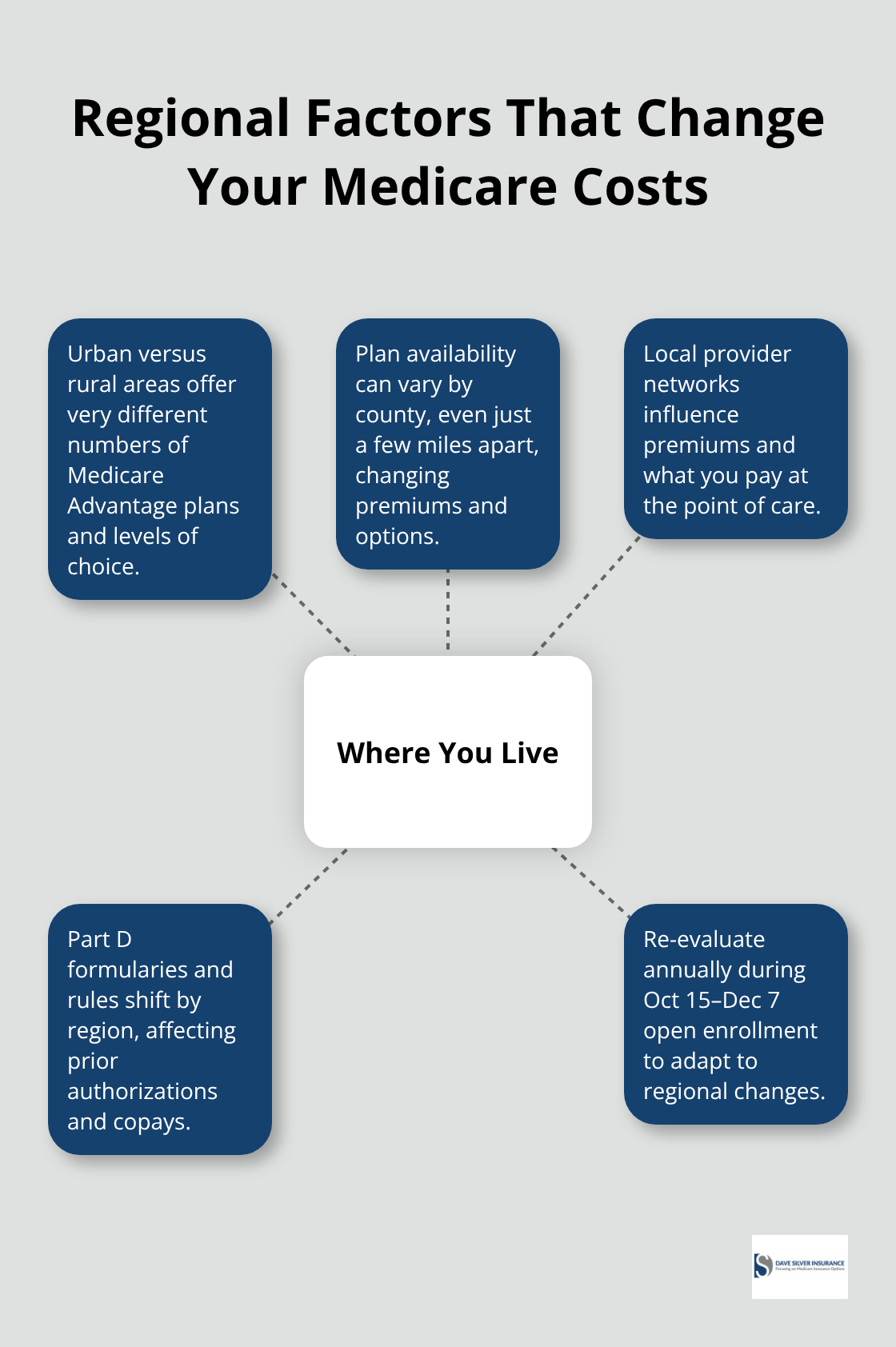
Your ZIP code determines plan availability and pricing more than most people realize. Rural areas often have fewer Medicare Advantage options, forcing beneficiaries into Original Medicare with higher out-of-pocket risk. Urban areas typically feature 10 to 30 different plans, creating genuine choice but overwhelming complexity. A plan available in one county might not exist five miles away, and premiums vary substantially by region even within the same state.
Average Medicare Advantage premiums fluctuate by region, reflecting local healthcare costs and provider networks. Your prescription drug formulary also shifts regionally-a medication covered under one plan’s Part D in your current location might require prior authorization or higher copayments if you move. These variations mean your ideal plan today might become unsuitable next year if circumstances change, requiring annual re-evaluation during open enrollment from October 15 through December 7.
Understanding these regional and structural differences positions you to identify which factors most impact your specific situation-a foundation you’ll need when examining the personal elements that shape your Medicare quote.
Key Factors That Affect Your Medicare Quote
Your Age and Enrollment Date
Your age at enrollment locks in permanent rate adjustments that follow you through retirement, making your enrollment timing one of the most consequential decisions you’ll make. If you enroll in Medicare at 65, your Part B and Part D premiums establish a baseline; if you delay Part B enrollment past 65 without qualifying for an exception, you face a 10% premium penalty for each year you waited, and this penalty sticks with you permanently. The Centers for Medicare and Medicaid Services data shows that someone delaying Part B enrollment by three years pays 30% more monthly for life.
Your actual age also matters: premiums for Medicare Advantage and Part D plans increase annually, but the increases compound faster in your late 70s and 80s. This acceleration means your plan choice at 75 carries different financial weight than your choice at 65.
Income Level and Subsidy Eligibility
Income level directly determines whether you qualify for Extra Help, a program that reduces Part D premiums and cost-sharing for individuals earning below 150% of the federal poverty line (roughly $20,385 annually in 2024). If your Modified Adjusted Gross Income exceeds $97,000 as an individual or $194,000 as a married couple filing jointly, you’ll pay Income-Related Monthly Adjustment Amounts on top of your standard Part B and Part D premiums, sometimes adding $70 to $350 monthly depending on your income bracket.
Pre-existing Conditions and Health Status
Pre-existing conditions don’t increase your premiums under Medicare rules, but they absolutely determine which plans make financial sense for your situation. If you take five or more medications regularly, a plan with a lower premium but high copayments on your specific drugs will cost you far more annually than a slightly pricier plan with better formulary coverage. The Kaiser Family Foundation reports that beneficiaries with chronic conditions like diabetes or heart disease spend $4,500 to $8,000 more annually on healthcare than healthy peers, making plan selection extraordinarily consequential.
Your prescription medication list should drive your plan choice, not the other way around. Cross-reference your exact medications against each plan’s formulary before comparing premiums, because a $50 monthly premium difference becomes irrelevant if one plan requires $200 copayments for your blood pressure medication while another charges $15.
Specialist Visits and Network Verification
Specialist visits matter significantly: if you see a rheumatologist quarterly, a Medicare Advantage plan with a $50 specialist copay costs substantially less than Original Medicare with 20% coinsurance on specialist fees. Network adequacy requires real verification too-call your preferred doctors directly and confirm they participate in the specific plan you’re considering, because network listings sometimes lag reality and you could face out-of-network rates unexpectedly.
This verification step separates plans that look good on paper from plans that actually work for your healthcare needs. Once you understand how these personal factors shape your quote, you’re ready to move into the practical work of comparing specific plans side by side.
Comparing Your Plans with Real Numbers
Stop Fixating on Monthly Premiums
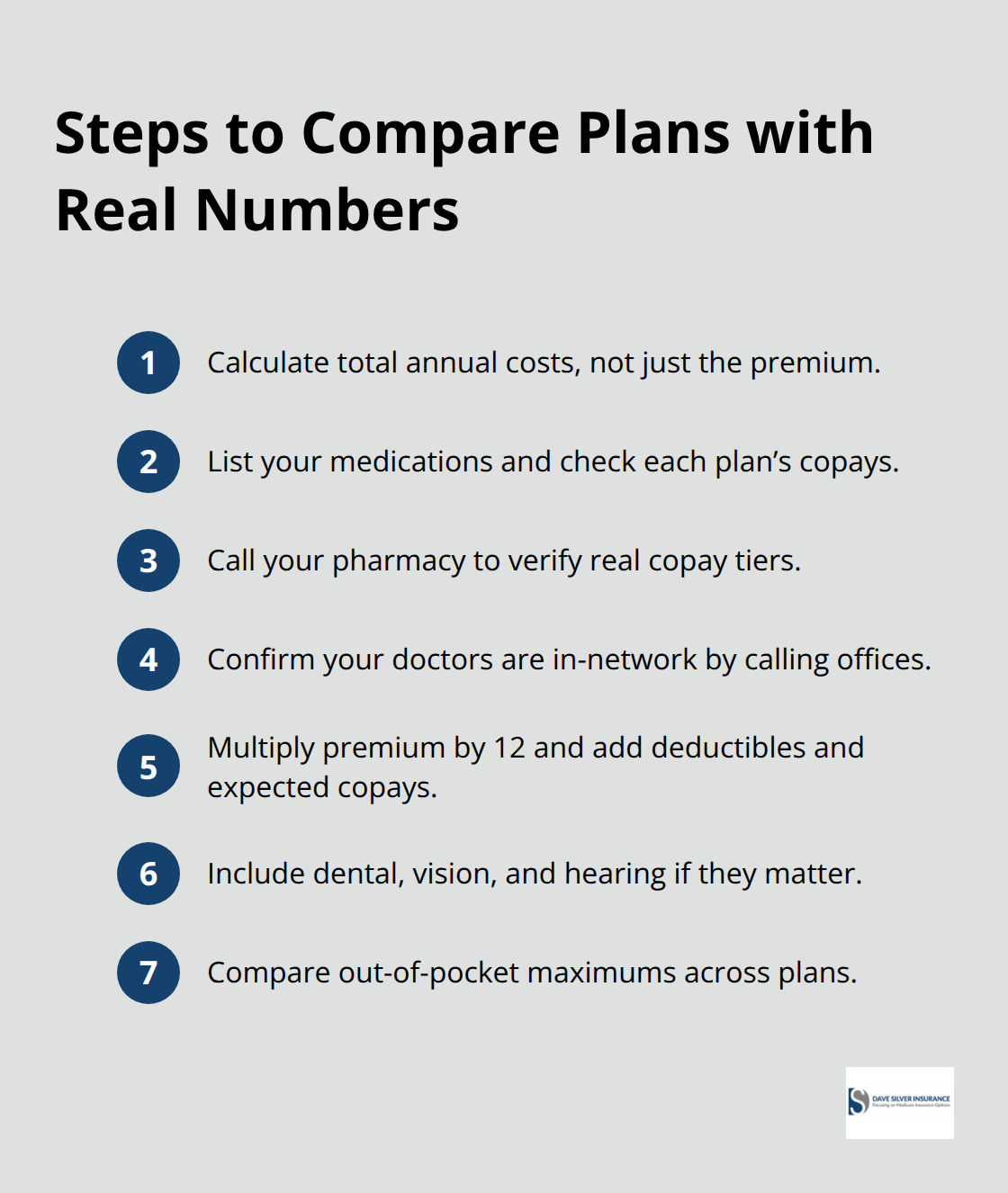
The moment you calculate total annual costs instead of comparing premiums in isolation, your Medicare decision shifts from confusing to concrete. Most people fixate on the monthly premium because it’s visible and easy, but that number represents maybe 20 to 30 percent of your actual spending. The real cost emerges when you add deductibles, copayments for your specific medications, specialist visits you actually need, and the out-of-pocket maximum you might hit if health problems develop.
List Your Medications and Verify Copayments
Start with every medication you take regularly, then cross-reference the exact copayment or coinsurance for each drug in every plan you’re considering. A plan charging $15 for your diabetes medication but $60 for your blood pressure drug costs differently than one charging $35 for both. This step takes 30 minutes per plan but prevents thousands in annual overspending.
Call the pharmacy where you actually fill prescriptions and verify copayments directly, because online formularies sometimes show outdated information or fail to account for tier placement changes. The pharmacy staff can confirm whether each plan covers your medications and at what cost tier, giving you accurate numbers rather than estimates.
Verify Network Participation and Calculate Real Costs
Verify your doctors participate in each plan’s network by calling their offices directly, not relying on plan websites. Ask specifically whether they’re accepting new Medicare Advantage patients in that particular plan, because some doctors participate broadly but have closed their panels for specific plans.
Then calculate your realistic annual costs using this formula: monthly premium multiplied by 12, plus your annual deductible, plus your expected copayments based on how many doctor visits and prescriptions you actually need annually, plus any specialist copays. For someone taking four medications, seeing their primary care doctor four times yearly, and visiting a specialist twice annually, the difference between plans often exceeds $1,500 to $3,000 annually once you account for formulary coverage and network copayments.
Account for Supplemental Benefits and Out-of-Pocket Maximums
Don’t forget to include dental, vision, and hearing costs if those matter to you, since Original Medicare covers none of these while some Medicare Advantage plans offer limited benefits. The Kaiser Family Foundation reports that beneficiaries with Medicare Advantage plans spend on average $500 to $800 annually out-of-pocket, compared to $1,200 to $1,800 for Original Medicare beneficiaries with supplemental coverage, but these averages hide massive individual variation based on health needs and plan selection precision.
Your calculation reveals which plan genuinely costs least for your specific situation, not someone else’s. Original Medicare has no annual out-of-pocket maximum, while Medicare Advantage plans cap your annual spending (typically $6,700 to $7,550 in 2024). This protection matters enormously if you face unexpected hospitalizations or intensive treatments.
Final Thoughts
Your healthcare utilization patterns determine whether you actually need comprehensive coverage or can operate efficiently with higher deductibles and lower premiums. Someone with stable health who visits their doctor twice yearly and takes one medication operates under completely different financial math than someone managing diabetes, heart disease, and arthritis with quarterly specialist visits and eight medications. This honest assessment of your actual healthcare needs prevents you from paying for coverage you’ll never use or skimping on protection you desperately need.
Medigap insurance deserves serious consideration if you choose Original Medicare, since it covers the 20% coinsurance and deductibles that Original Medicare leaves exposed. Medigap Plan G covers most out-of-pocket costs except the Part B deductible, while Plan N offers lower premiums but requires copayments for doctor visits and emergency room care. Someone paying $150 monthly for Medigap Plan G might spend $1,800 annually in premiums but face minimal additional costs, while someone with Plan N might pay $80 monthly but encounter $500 to $1,000 in copayments depending on healthcare usage.
We at Dave Silver Insurance help you navigate Medicare quotes pricing with personalized recommendations based on your specific health needs and financial situation. Our team understands that Medicare coverage varies dramatically based on individual circumstances, and we’re accessible seven days a week to answer your questions before enrollment. Schedule a consultation to discuss your options with someone who knows Medicare inside and out.
Disclaimer: The information provided in this blog is for general informational purposes only and does not constitute legal, financial, or insurance advice. Coverage options, terms, and availability may vary. Please consult with a licensed professional for advice specific to your situation