
Missing your Part D enrollment window can cost you thousands in penalties and higher premiums. We at Dave Silver Insurance know that Medicare drug coverage deadlines are confusing, and one mistake can follow you for years.
This guide walks you through the exact dates you need to know, how to qualify for special enrollment periods, and how to pick a plan that actually fits your budget.
What Happens If You Miss Part D Deadlines
Medicare Part D is prescription drug coverage that works alongside Original Medicare, and you cannot avoid it without facing permanent penalties. According to Medicare.gov, the program covers thousands of medications, but you must enroll during specific windows or a penalty on your premium accumulates for every month you delay. Missing deadlines costs real money-someone who enrolls 14 months late pays an extra penalty in 2026. That penalty sticks with you for life, even if you switch plans.
The Annual Enrollment Window You Cannot Miss
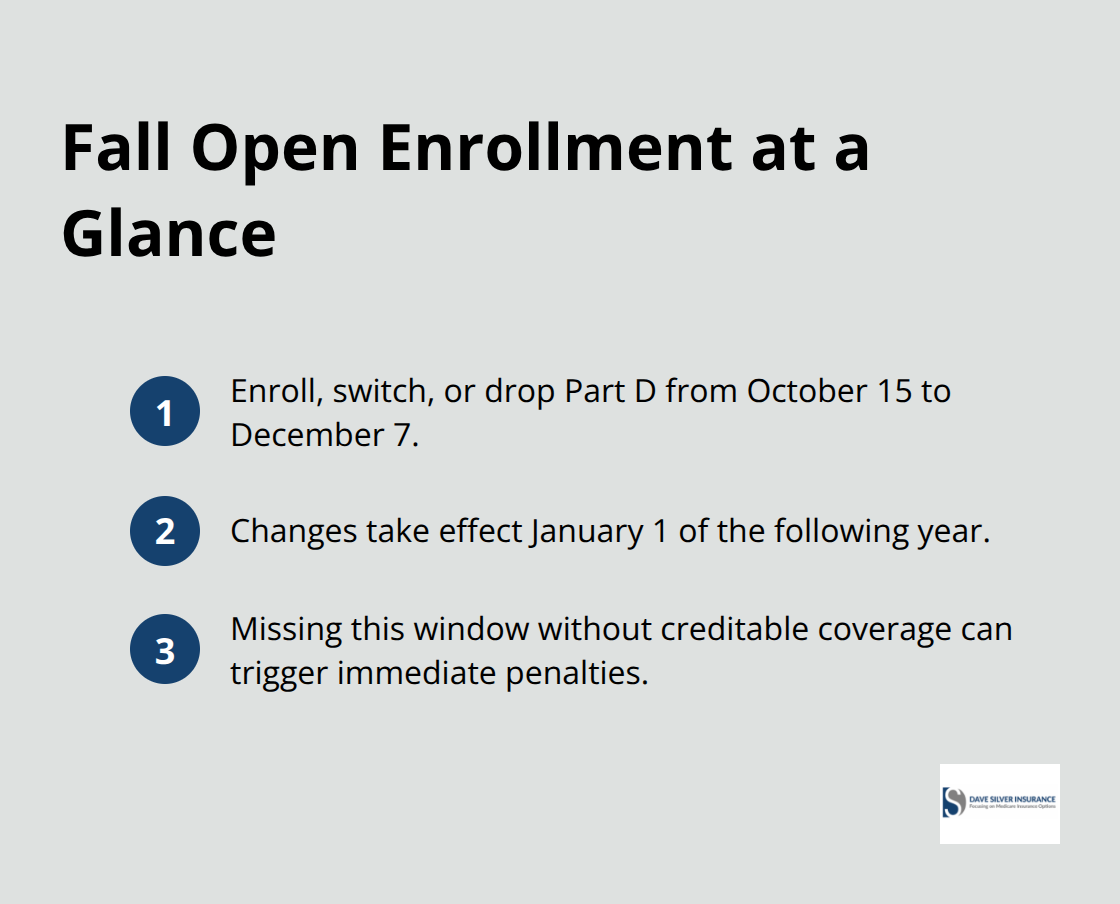
Fall Open Enrollment runs from October 15 through December 7 each year, and this is your main chance to enroll in Part D, switch plans, or drop coverage. Medicare.gov confirms that any changes you make during this window take effect on January 1 of the following year, giving you two and a half months to research your options. If you’re already in Original Medicare, this period offers your easiest path to Part D without penalties. However, if you miss this window and lack creditable drug coverage from another source, you cannot enroll until the next enrollment period, and penalties begin accumulating immediately.
When Your Initial Enrollment Period Actually Starts
Your first chance to enroll in Part D comes during your Initial Enrollment Period, which spans seven months around your 65th birthday according to Medicare.gov. This includes three months before the month you turn 65, the month itself, and three months after. If you enroll during the first three months of this window, your Part D coverage begins on the first day of the fourth month. If you wait and enroll during the fourth month or later in your Initial Enrollment Period, coverage starts the month after you enroll. The timing matters because gaps in coverage of 63 days or more trigger the permanent late enrollment penalty, so enrolling early in your Initial Enrollment Period protects you from this trap.
The True Cost of Waiting
The Part D late enrollment penalty uses a national base beneficiary premium that changes annually. For 2026, this base premium is $38.99, and the penalty applies for each month you could have enrolled but didn’t. This penalty does not disappear when you switch plans or when you reach a certain age-it stays on your premium permanently as long as you have Medicare drug coverage. The only exception occurs if you had creditable drug coverage from an employer, union, or other source during the gap, which you must document to prove to your plan.
Special Enrollment Periods Offer a Second Chance
Life events can open enrollment windows outside the standard periods, allowing you to enroll in Part D without penalties even if you missed your Initial Enrollment Period or Fall Open Enrollment. Qualifying events include moving outside your plan’s service area, losing employer coverage, gaining Medicaid eligibility, or experiencing other documented circumstances. These Special Enrollment Periods typically last two months from the qualifying event, and Medicare.gov outlines the specific rules for each situation. Understanding which life events qualify for these windows can save you thousands in penalties and help you secure coverage when you need it most.
When Life Events Open New Part D Enrollment Windows
Life events create windows to enroll in Part D outside the standard periods, and understanding which situations qualify can prevent you from being locked out of coverage for months. You can make changes to your Medicare Advantage and Medicare drug coverage when certain events happen in your life, like if you move or you lose other coverage.
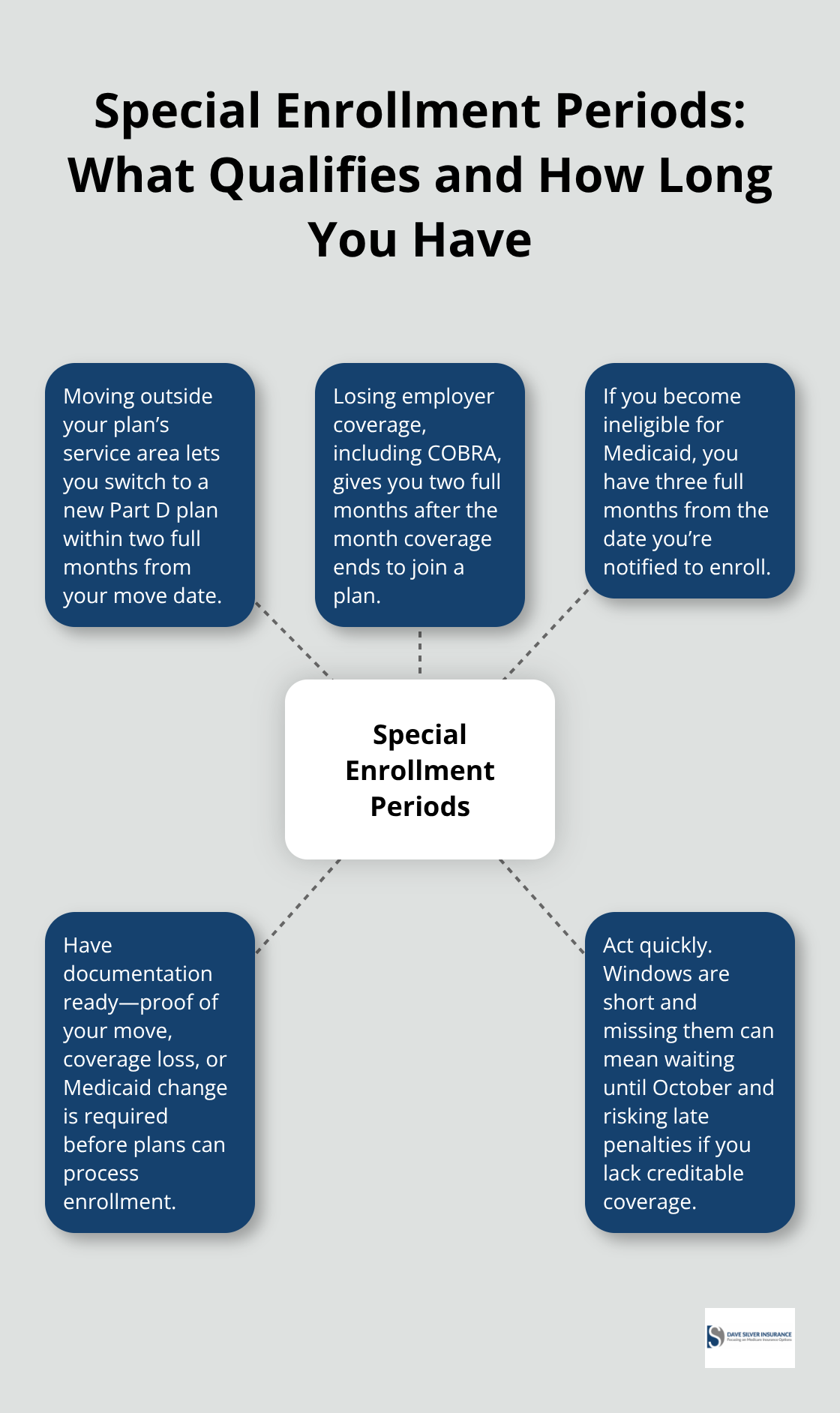
If you move to a new address outside your current plan’s service area, you can switch to a new Part D plan within two full months starting from your move date. Losing employer coverage, including COBRA, gives you two full months after the month your coverage ends to join a Part D plan. If you become ineligible for Medicaid, you have three full months from the date you’re notified to enroll. Each of these windows operates differently, and missing the specific deadline for your situation means waiting until the next Annual Enrollment Period in October, potentially triggering late enrollment penalties if you lack creditable coverage during the gap.
Documentation Proves Your Qualifying Event
Medicare.gov requires proof that a qualifying event occurred before you can enroll during a Special Enrollment Period, and submitting inadequate documentation will delay or deny your enrollment. When you move, provide documentation showing your new address, such as a utility bill or lease agreement dated within the last two months. If you lost employer coverage, keep your termination letter, final pay stub, or a letter from your employer confirming the coverage end date. For Medicaid changes, obtain written notification from your state Medicaid agency showing the exact date your eligibility ended. Institutions like nursing homes require documentation from the facility confirming your residency dates.
Submission Timing and Plan Processing
Submit documentation directly to the plan you want to join, not to Medicare, and request written confirmation that they received it. Without these documents, the plan has grounds to reject your enrollment or delay processing it past your Special Enrollment Period window, leaving you uninsured and vulnerable to penalties. Most plans process Special Enrollment Period applications within two weeks, but delays happen when documentation is incomplete or unclear. Contact the plan after one week if you haven’t received confirmation of your enrollment status. Staying on top of this timeline prevents gaps in your coverage and protects you from accumulating penalties that would otherwise follow you for years.
Now that you understand how life events unlock enrollment opportunities, the next step involves selecting a plan that matches your medications and budget.
How to Pick a Part D Plan That Covers Your Medications
Picking a Part D plan requires you to compare three critical elements: which drugs the plan covers, what you’ll pay out of pocket, and whether your pharmacy participates in the network. Most people focus only on the monthly premium, which is a mistake that costs them hundreds annually. The plan with the lowest premium often has the highest copays for your specific medications or excludes drugs you take regularly. Medicare.gov provides a plan comparison tool where you enter your current medications and it shows you exactly what each plan charges for those drugs, including deductibles and coinsurance. This step takes 15 minutes and eliminates guesswork entirely.
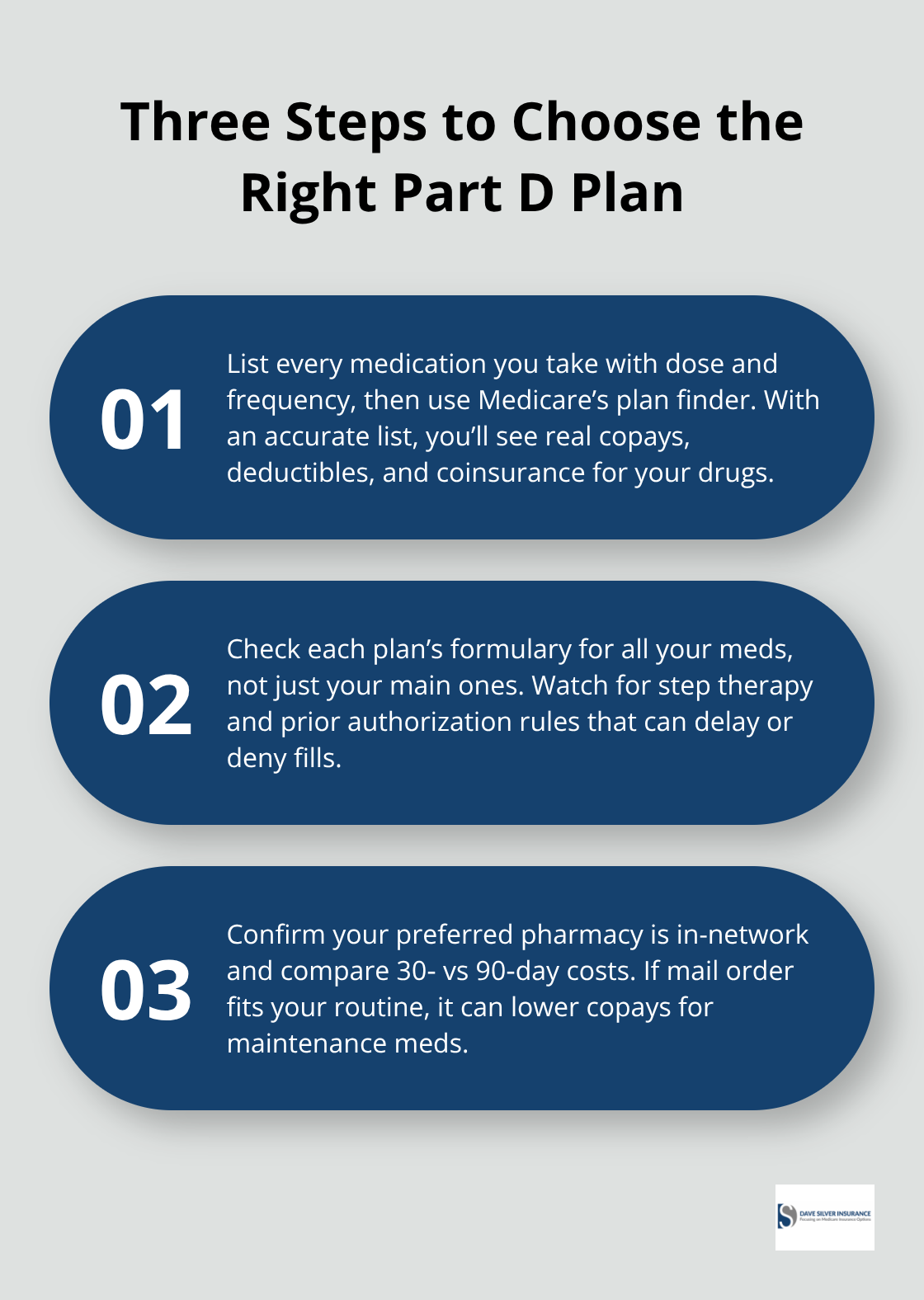
Start by gathering your prescription bottles or a list from your pharmacy showing every medication you take, the dosage, and how often you refill it. Without this list, any plan comparison remains incomplete.
Your Formulary Determines What You Actually Pay
Each Part D plan publishes a formulary-the official list of covered medications-and this document controls whether your drugs are affordable or excluded entirely. Plans can refuse to cover certain medications, require you to try a cheaper alternative first through a process called step therapy, or demand prior authorization from your doctor before they’ll pay for the drug. A plan might cover your blood pressure medication but your arthritis drug, forcing you to choose between coverage and your health needs.
Check the formulary for every medication you take, not just your primary ones, because many people take multiple prescriptions and plans cover them unevenly. If a drug you need isn’t on the formulary, that plan is unsuitable regardless of its premium price. Contact the plan directly if the online formulary is unclear, and ask specifically whether step therapy or prior authorization applies to your medications.
Plans change their formularies annually, so a plan that worked perfectly this year might exclude your drug next year. This is why you must compare plans every October during Fall Open Enrollment rather than assuming your current plan remains the best choice.
Pharmacy Networks Matter as Much as Drug Coverage
Your preferred pharmacy must be in the plan’s network, or you’ll pay significantly more for prescriptions. Some plans exclude major pharmacy chains like CVS or Walgreens in certain areas, forcing you to switch to unfamiliar locations or mail-order services. If you have a long-standing relationship with a local pharmacy where the staff knows your medication history, losing access to that pharmacy disrupts your care unnecessarily.
Check the plan’s pharmacy network before you enroll by searching their website or calling the plan to confirm your specific pharmacy location participates. Mail-order pharmacies included in plans often offer lower copays for 90-day supplies, which saves money if you take maintenance medications long-term, but they require advance planning and may not work for medications you need quickly.
Verify both your preferred pharmacy and your doctors are in-network before you enroll, because switching providers mid-year creates gaps in care and medication management.
Final Thoughts
Your Part D enrollment window closes fast, and missing your Initial Enrollment Period or waiting until the last day of Fall Open Enrollment puts you at financial risk. The penalties accumulate immediately and follow you permanently, making the difference between affordable medication and unmanageable costs. Act now by gathering your medication list, visiting Medicare.gov’s plan comparison tool, and spending 15 minutes comparing available plans in your area.
Check that your pharmacy and doctors participate in each plan’s network before you enroll. Write down the three plans that best match your medications and budget, then select the one that fits your needs. If you qualify for a Special Enrollment Period due to a life event, submit your documentation immediately to avoid processing delays that could leave you uninsured.
We at Dave Silver Insurance understand that Medicare decisions feel overwhelming, which is why we offer personalized guidance on Part D and all your Medicare options. Contact Dave Silver Insurance to discuss your Part D enrollment window choices with someone who knows the details inside and out. Your enrollment window is open now, and taking action today protects your health and your wallet for years to come.
Disclaimer: The information provided in this blog is for general informational purposes only and does not constitute legal, financial, or insurance advice. Coverage options, terms, and availability may vary. Please consult with a licensed professional for advice specific to your situation