

Losing a spouse changes everything-including how you approach Medicare. Your coverage options shift, your income picture changes, and your healthcare needs may look different than before.
At Dave Silver Insurance, we’ve helped many widows navigate Medicare enrollment after spousal loss. The good news is that you qualify for a special enrollment period, which opens up plan changes that aren’t normally available. This guide walks you through the specific steps widows should take to adjust their Medicare coverage and reduce costs.
What Coverage Changes When Your Spouse Passes Away
When your spouse dies, your Medicare situation fundamentally shifts. If your spouse had employer-sponsored coverage or a Medicare Advantage plan, that coverage ends immediately upon their death. You cannot continue their plan, and COBRA continuation does not apply to Medicare benefits themselves. What matters now is your own eligibility and coverage choices.
Premium-Free Part A Based on Spouse’s Work History
According to the Social Security Administration, if you were married for at least 12 months before your spouse’s death and you remain unmarried or remarry after age 60, you may qualify for premium-free Part A based on their work history. This matters significantly because Part A premiums can cost up to $505 per month in 2026 if you lack the required work credits yourself. Your Special Enrollment Period begins the moment you lose your spouse’s coverage and lasts two full months after that coverage ends, according to Medicare.gov. During this window, you can enroll in a Medicare Advantage plan with drug coverage, switch to Original Medicare, or enroll in a standalone Part D plan without the typical penalties that apply outside enrollment periods.

Three Main Paths Forward
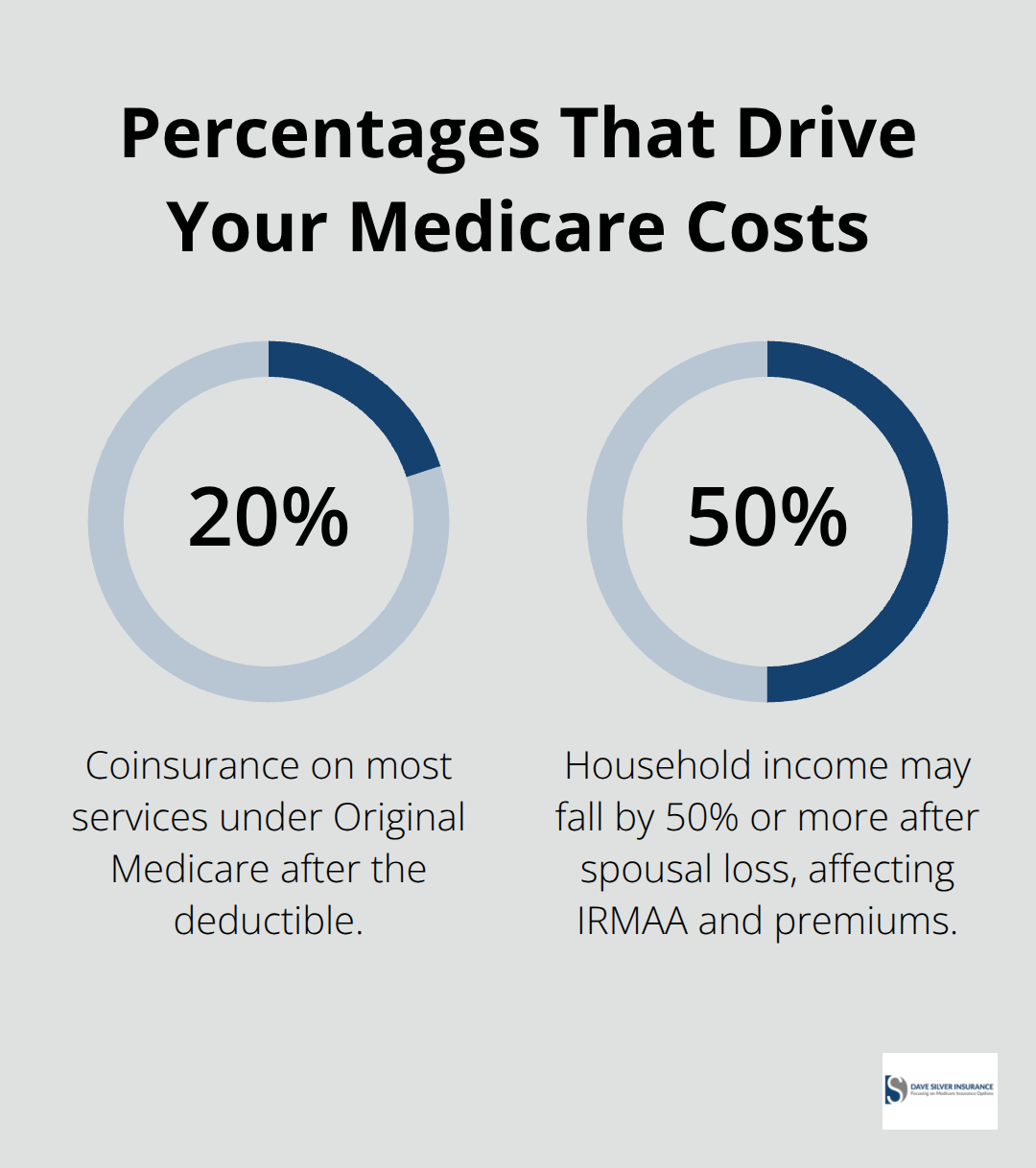
You face three main coverage options. Original Medicare Part A and Part B offer the most flexibility to see any healthcare provider nationwide, though you will pay 20 percent coinsurance for most services after meeting your deductible. Medicare Advantage plans combine Parts A, B, and often D into one plan, typically with lower out-of-pocket maximums but restricted networks. Medigap policies work alongside Original Medicare to cover what Medicare does not pay, reducing your unpredictable costs.

How Income Changes Affect Your Premiums
Your household income just changed dramatically with your spouse’s passing, which directly affects your Medicare premiums through Income-Related Monthly Adjustment Amounts (IRMAA). If your Modified Adjusted Gross Income drops significantly, you may qualify for lower Part B and Part D premiums. Contact the Social Security Administration at 1-800-772-1213 to report the death and request a benefit review; they can recalculate your income-based premiums based on your new single-filer status. The financial impact proves substantial: a widow moving from a joint income of $100,000 to a single income of $50,000 could see considerable reductions in Medicare costs, particularly if IRMAA previously applied.
Your new income level also determines whether you qualify for additional assistance programs that can further lower your out-of-pocket expenses during this transition period.
Choosing the Right Mix of Coverage for Your New Situation
Original Medicare vs. Medicare Advantage: Understanding Your Core Options
Your income just dropped, your healthcare needs remain the same or may have increased, and you now face coverage decisions alone. This is where most widows make costly mistakes by either over-insuring or under-insuring without considering how their financial situation has fundamentally shifted. Original Medicare Part A and Part B give you access to any provider nationwide, but you pay 20 percent coinsurance on most services after your deductible. If you had comprehensive employer coverage through your spouse, this gap feels shocking.
Medicare Advantage plans offer an alternative by capping your out-of-pocket maximum, typically between $6,700 and $7,500 annually according to Medicare.gov. Many Advantage plans include dental, vision, and hearing benefits that Original Medicare does not cover, which matters if you now need to manage healthcare costs alone. However, Medicare Advantage plans generally don’t have network providers-you can go to any Medicare-approved provider or facility that agrees to treat you.
How Medigap Fills the Gaps in Original Medicare
Medigap policies fill the coinsurance gap by covering what Original Medicare does not pay, with plans ranging from basic coverage to comprehensive options. A Medigap Plan G costs around $150 to $300 monthly depending on your age and location, while a Plan N typically runs $100 to $200 monthly. The trade-off is straightforward: higher monthly premiums mean predictable costs when you need care. Without Medigap, a single hospitalization or extended treatment could force you to pay thousands in coinsurance. Your reduced household income makes this protection more important, not less.
Evaluating Part D Prescription Drug Coverage
Part D prescription drug coverage requires separate evaluation. If your spouse handled medication management or had employer coverage that included drugs, you must now actively choose a standalone Part D plan or select a Medicare Advantage plan with drug coverage. Costs vary dramatically: some plans charge $5 monthly premiums while others exceed $100, and your copays depend entirely on which drugs you take and which tier they fall under. Use the Medicare Plan Finder tool at Medicare.gov to compare plans side-by-side based on your specific prescriptions, as generic versus brand-name medications can shift your annual costs by hundreds of dollars.
Acting Within Your Special Enrollment Period
Your Special Enrollment Period gives you two full months to make these decisions without penalties, but that window closes fast. Contact the Social Security Administration at 1-800-772-1213 immediately after your spouse’s death to report the change and request a benefit recalculation, as your income-based premiums typically decrease when you transition to single-filer status. This conversation also confirms whether you qualify for premium-free Part A based on your spouse’s work history, which eliminates one of your largest potential expenses. Many widows discover they qualify for Extra Help or Medicaid during this income recalculation, which can reduce Part D premiums to $0 and cover additional out-of-pocket costs.
Matching Your Coverage to Your Health Profile
The key decision hinges on your healthcare usage and risk tolerance: if you see multiple specialists or take multiple medications, Medigap with Original Medicare provides maximum flexibility and predictable costs despite higher premiums. If you rarely use healthcare beyond routine checkups, Medicare Advantage with its lower premiums and capped out-of-pocket costs may suit your budget better. Your answer depends entirely on your health history, not generic advice about what works for most people. Once you understand which coverage path aligns with your health needs and financial reality, the next step involves calculating exactly how much each option costs in your specific situation-and that’s where income changes and subsidy eligibility become your greatest financial tools.
How Your Income Drop Changes Your Medicare Costs
Your household income just fell by 50 percent or more, and this matters enormously for your Medicare premiums. Income-Related Monthly Adjustment Amounts (IRMAA) directly tie your Part B and Part D premiums to your Modified Adjusted Gross Income from two years prior. For high-income Medicare beneficiaries, Part B and Part D premiums include an additional charge based on your modified adjusted gross income. Now that you file as a single taxpayer with half that income, your IRMAA calculation changes dramatically.
Request an Immediate Income Recalculation
Contact the Social Security Administration at 1-800-772-1213 to file a life-event appeal requesting an immediate recalculation based on your current income. This single phone call often reduces your Part B premium by $50 to $100 monthly and your Part D premium by $20 to $50 monthly, depending on your income level. The Social Security Administration processes these requests within weeks, not months, so waiting costs you money every single month you delay.
Discover Programs That Reduce Your Drug Costs
Many widows qualify for Extra Help, a federal program that reduces Part D premiums to zero and covers most copays on prescription drugs. Your reduced income may also trigger Medicaid eligibility depending on your state, which covers Medicare premiums and cost-sharing that Original Medicare leaves unpaid. These programs exist specifically for situations like yours, yet most widows never apply because they do not know they qualify.
Calculate Your Actual Healthcare Spending
Your out-of-pocket expenses on a single income require ruthless prioritization. If you chose Original Medicare with Medigap, your monthly premiums likely range from $250 to $400 depending on your age and location, but this protects you from catastrophic costs when serious illness strikes. If you selected a Medicare Advantage plan instead, your premiums run lower at $0 to $150 monthly, but your out-of-pocket maximum caps your annual costs between $6,700 and $7,500 according to Medicare.gov.
The choice between these paths hinges on your actual healthcare spending, not on what feels safer. Pull your final medical bills from your spouse’s last two years of life and calculate what you would have paid under each plan type. If your spouse spent $15,000 annually on healthcare, a Medigap plan with predictable costs prevents financial shock when you face similar expenses alone. If your spouse spent $2,000 annually, Medicare Advantage’s lower premiums preserve your monthly cash flow when every dollar matters.
Match Your Part D Plan to Your Medications
Your Part D plan selection deserves equal attention because generic medications cost $4 to $15 monthly at most pharmacies, while brand-name drugs on unfavorable formularies can exceed $200 monthly. Use the Medicare Plan Finder at Medicare.gov and enter every medication you take to compare actual copays across plans, not just premium prices. Many widows save $600 to $1,200 annually by switching to a plan with better formulary coverage for their specific drugs (money that goes directly back into your household budget during this financially vulnerable transition).
Final Thoughts
Widows must make three critical Medicare decisions after spousal loss: confirm premium-free Part A eligibility based on your spouse’s work history, request an immediate income recalculation to lower your IRMAA premiums, and select coverage that matches your actual healthcare spending rather than your fears. Most widows overpay by choosing plans based on what feels safest instead of what their health profile and reduced income actually require. Your Special Enrollment Period lasts only two months, so delaying these decisions costs you money every single month you wait.
The financial stakes matter enormously when you navigate Medicare for widows. A widow who requests an income recalculation within weeks of spousal loss saves $50 to $100 monthly on Part B premiums alone, while selecting the right Part D plan based on actual prescriptions saves another $600 to $1,200 annually. These represent real money that stays in your household budget during a financially vulnerable transition.
Professional guidance during this transition prevents costly mistakes that compound over years. Contact Dave Silver Insurance to discuss your coverage options, confirm your eligibility for premium-free Part A, and calculate your actual costs under each plan type. This conversation clarifies which path aligns with your health needs and financial reality, transforming Medicare from overwhelming to manageable during this difficult transition.
Disclaimer: The information provided in this blog is for general informational purposes only and does not constitute legal, financial, or insurance advice. Coverage options, terms, and availability may vary. Please consult with a licensed professional for advice specific to your situation